Facing a 'no driving tests available in the UK' issue? Discover the backlog reasons and learn strategies to secure your test date with our comprehensive guide.
Facing a 'no driving tests available in the UK' issue? Discover the backlog reasons and learn strategies to secure your test date with our comprehensive guide.
Test Centre: Wood Green
Date: 22nd April 2026
Test Centre: Pinner
Date: 31th April 2026
Test Centre: Croydon
Date: 4th May 2026
Test Centre: Erith
Date: 7th May 2026
Test Centre: Barking (Tanner Street)
Date: 9th May 2025
Test Centre: Isleworth
Date: 18th May 2026
Test Centre: Hendon
Date: 4th May 2025
Test Centre: Hither Green
Date: 27th May 2026
Test Centre: Tolworth (London)
Date: 1st May 2026
Test Centre: Tolworth (London)
Date: 1st May 2026
If you’ve spent hours staring at the government booking website, hitting ‘refresh’ only to see ‘no appointments available,’ you are not alone. It’s a frustrating ritual shared by hundreds of thousands of learners across the country, making the goal of getting a UK driving test feel almost impossible. But this isn't a simple website glitch or a personal run of bad luck; it’s the result of a massive national backlog.
So why are there no driving tests available? While the pandemic certainly kickstarted the problem, the real answer is a "perfect storm" of issues that have been brewing for years. According to the Driver and Vehicle Standards Agency (DVSA), the initial shutdown created an instant shortfall of nearly half a million tests. This crisis was then layered on top of pre-existing examiner shortages and complicated further by industrial action, creating the driving test backlog we see today.
By understanding how each of these factors—from COVID-19 to examiner strikes—contributed to the current situation, you can gain clarity on the system you are up against and learn the most effective strategies for finally securing that all-important test date.
The primary reason for today’s driving test delays can be traced back to the national lockdowns. For months on end, all testing ground to a halt. You can think of the entire system as a busy motorway; during the pandemic, every entrance ramp was closed. While the road was blocked, hundreds of thousands of new learners were still arriving, creating a massive queue that had nowhere to go. This shutdown didn't just cause a pause; it created the foundation for an unprecedented backlog.
When tests eventually resumed, things didn't just snap back to normal. Strict social distancing rules meant that test centres couldn't operate at full capacity. Examiners needed extra time between appointments to clean vehicles and manage the number of people in waiting rooms. In our motorway analogy, the road had finally reopened, but only one lane was in use and the speed limit was drastically reduced. As a result, the queue of waiting learners grew even longer, even as tests were being conducted.
The scale of this problem quickly became clear. Before the system was even fully up and running again, the initial backlog had swollen to include more than 500,000 learners waiting for a slot. This colossal 'traffic jam' became the central challenge for the government body responsible for overseeing driving standards and clearing the waiting list: the Driver and Vehicle Standards Agency, better known as the DVSA.
You’ve likely interacted with the DVSA, perhaps without even realising it. The Driver and Vehicle Standards Agency is the official government body responsible for setting driving standards and conducting every car, lorry, and motorcycle test in Great Britain. That frustrating booking page you’ve been refreshing on the GOV.UK website? That’s the DVSA’s system, and they are the organisation tasked with managing the immense pressure of the test backlog.
At its core, the DVSA's primary mission is to ensure that only safe and competent drivers are allowed on the road. This focus on public safety is the lens through which it views the entire crisis. It dictates the high standards that new examiners must meet and explains why simply rushing people through tests isn't an option. With this in mind, the question becomes less about speed and more about capacity: why can't the agency just hire more examiners to meet the demand?
On the surface, hiring more examiners seems like the obvious solution to the driving examiner shortage in the UK. However, bringing new staff on board is a slow and complex process. Becoming a driving examiner isn’t like starting an office job; each new recruit must complete an intensive training course that lasts for months. This ensures every test across the country is conducted to the same high standard, a non-negotiable part of the DVSA’s commitment to road safety.
Even before this lengthy training can start, the agency faces a more fundamental problem: finding the right candidates. Not every good driver can be a good examiner. The role requires a specific blend of patience, calm decision-making under pressure, and the ability to assess hundreds of different drivers fairly. In a competitive job market, attracting people with this unique skill set to a public sector role can be a significant challenge, creating a bottleneck before the first day of training.
Trying to increase the number of examiners is like trying to fill a leaky bucket with a slow-running tap—progress is gradual and easily offset by other pressures. Unfortunately, while the DVSA works to bring in new staff, factors like industrial action have only made the situation worse, adding yet another layer of complexity to the extended driving test waiting times.
While the DVSA works to bring in new staff, recurring industrial action has been actively reducing the number of available tests. When driving examiners go on strike over pay and conditions, every test they were scheduled to conduct is cancelled. This isn't just a postponement; it's a direct hit to the system. With thousands of appointments wiped out during strike periods, learners who had secured a precious slot are sent right back to the start of the queue, making the waiting list even longer.
At the same time, the number of people wanting to take a test has soared. Think of it like trying to buy tickets for a hugely popular concert. The venue has a fixed number of seats (the test slots), but the number of fans trying to buy them (the learners) has skyrocketed. A growing population of young drivers, combined with those who delayed learning during the pandemic, means demand is now at an all-time high, putting immense pressure on the already limited supply.
This combination of fewer available tests and more learners needing them creates a perfect storm of scarcity. The official booking system simply can't cope with the overwhelming demand. It’s this intense competition for a handful of slots that has created a new, unofficial market, leading many desperate learners to wonder if there’s another way to get a test.
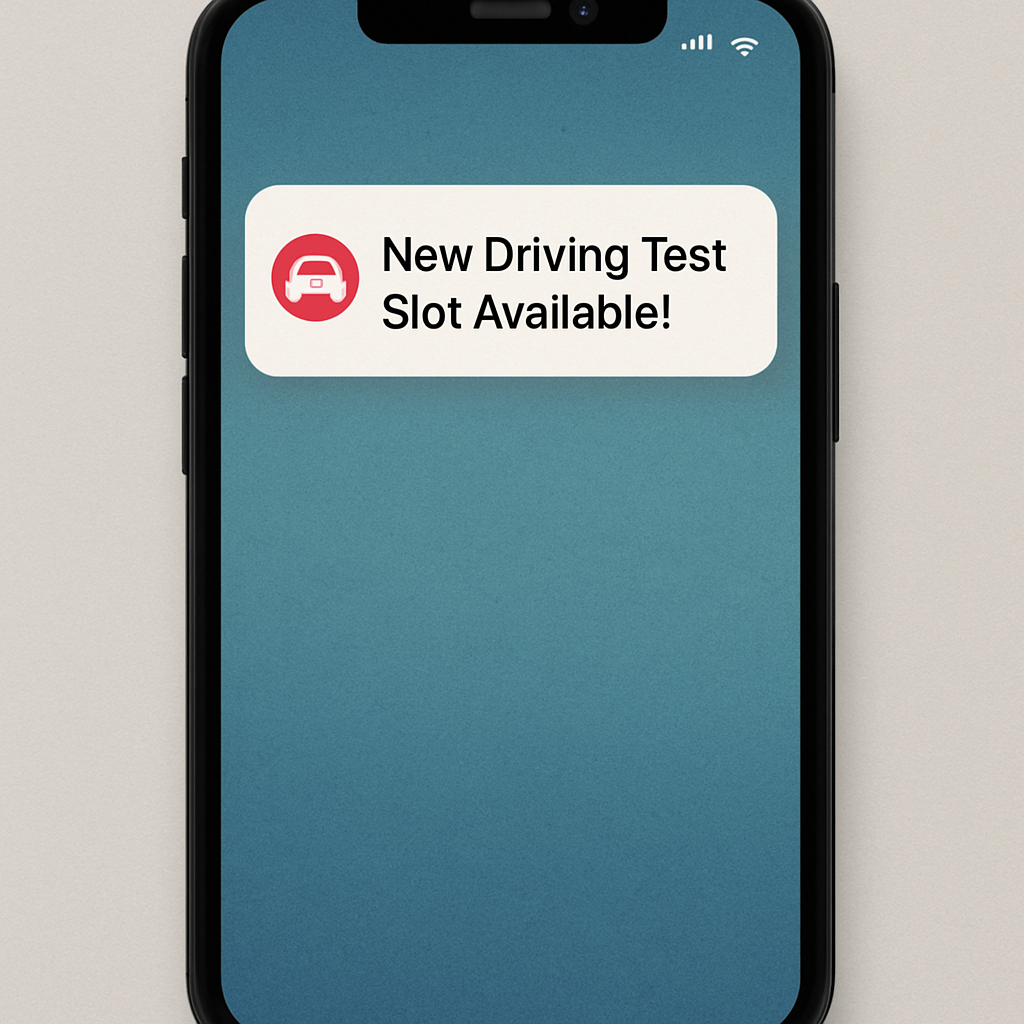
This intense scarcity has given rise to a digital gold rush. Frustrated learners, tired of endlessly refreshing the DVSA website, are turning to a new kind of tool: driving test cancellation apps. These services promise to do the hard work for you, finding and sometimes even booking those elusive test slots the moment they appear. But how do they work, and are they worth it?
At their core, these apps are powered by automated programs, often called 'bots'. Imagine a robot that does nothing but sit on the DVSA booking website 24/7, hitting the refresh button thousands of times a day. The second a test slot becomes available—perhaps from someone else's cancellation—the bot spots it instantly. It then sends a notification straight to your phone, giving you a chance to grab it before anyone else. This is how to find driving test cancellations far faster than a human ever could.
While they sound like a perfect solution, using these driving test bots involves a trade-off. They aren't an official service, and they come with both benefits and drawbacks.
Ultimately, these apps are a symptom of the broken system—a paid shortcut that exists only because the official path is so congested. They offer a potential solution for those willing to pay, but they aren’t a guaranteed ticket to a test. For learners who prefer to stick to official channels, knowing when the DVSA releases new batches of tests is key.
Sticking to the official route means knowing the system’s schedule. The Driver and Vehicle Standards Agency (DVSA) releases brand new blocks of test slots at one key time: 6 am every Monday morning. These are not last-minute appointments; the system books up to 24 weeks in advance, so any slot you secure will likely be nearly six months away. This weekly ‘drop’ is the most predictable moment for checking for driving test availability, but it only gives you a date in the distant future.
Cancellations, however, are far more unpredictable. A cancelled test can reappear on the booking portal at any moment—day or night. When a learner cancels, their slot is immediately put back into the system for anyone to grab. Finding one of these is about luck and persistence, making the hunt for a test at short notice feel more like a lottery. This is how some learners manage to find a test just weeks, or even days, away without using a third-party app.
A practical strategy is twofold. Be on the website at 6 am on Monday to try for a new, long-term date. Then, continue checking for availability at random times throughout the week. People often manage their bookings in the morning or evening, so these can be good times to spot a cancellation. Ultimately, whether your test is in six months or six days, the most important factor is being fully prepared and test-ready when your day finally arrives.
The 'no appointments available' message on the booking site is more than a random, personal frustration—it's the result of a national system caught in a perfect storm of a pandemic backlog, examiner shortages, and unprecedented demand. While the problem is complex, your path forward can be simple.
When no driving tests are available, the most powerful move isn't endlessly refreshing the booking page. The best advice is to shift your focus from the screen to the steering wheel. Work with your instructor to become so proficient that passing is a near certainty, and get their confirmation that you are 100% ready before you even begin the search.
This approach transforms powerless waiting into powerful preparation. By aiming for a first-time pass, you aren’t just navigating the backlog; you are taking control of your journey, saving yourself time, money, and stress. You’re no longer just waiting in line—you’re ensuring your turn is the only one you’ll need.
📚 Part of our Driving Test Booking Guide
This article is part of our comprehensive guide. View all Driving Test Booking articles →